Tuesday, April 20th, 2010
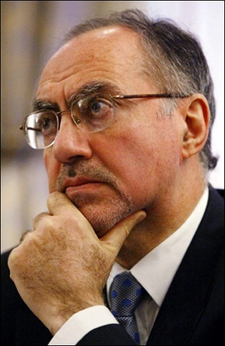
Ali Allawi. Few people combine real life experience with spiritual insight as much as Ali Allawi. He has a deep appreciation for the spiritual education once provided by the Sufi orders and the need for reviving an effective language of spirituality. We were delighted to learn that he is also closely associated with our dear friend, Shaykh Fadhlalla Haeri, and thus deeply acquainted with the path of spiritual experience. He has also held positions of responsibility as Minister of Trade and Minister of Defense in the cabinet appointed by the Interim Iraq Governing Council from September 2003 until 2004, and subsequently Minister of Finance in the Iraqi Transitional Government between 2005 and 2006.
The following is an excerpt from Ali Allawi’s The Crisis of Islamic Civilization (With permission from Yale University Press).
The recovery of the sacred, which is integral to any hope for the recovery of Islamic civilization, revolves around the notion of ihsan, the third essential dimension of Islam. In the sensibility of the times, this might veer towards tedious or sanctimonious moralizing, but ihsan has nothing to do with controlling or moulding outer forms of behaviour. It is a conscious pursuit on the part of the individual to perfect virtuous qualities which are associated with the inner spiritual journey. This pursuit was undertaken in the past through affiliation to the various Sufi tariqas, which had millions of adherents and adepts, or, in the Shia lands, through the more individualist and even solitary path of irfan, the metaphysical form of Sufism, which was acceptable to the Shia consciousness. The tariqas cannot be compared to the monastic orders of Christianity, if only because of their scale and ubiquity in Islamic public life. The modernist and Islamist assault on the spiritual paths of Islam destroyed a crucial form of organization which had encouraged the inculcation of moral qualities in the mass of the population as well as in the elites. It was not replaced with anything better than just an alternative: of either a dry ‘rationalist’ or scholastic Islam, or the doubts and moral ambiguities which are a feature of secular life. The ihsan aspect of Islam was degraded over time and, with it, nearly all the features of Islamic life that were marked by charitable works, communal solidarity and social concern. . . Although the traditional Sufi orders may be well past their prime as a vehicle for spiritualizing the masses, the deeper yearning which they had earlier addressed still remains.
Posted in ARTICLES | Comments Off
Saturday, April 17th, 2010
posted by Nathan Schneider
Reza Aslan stirs the pot and offers some valuable insights in this stimulating interview–no need to agree with every word of it. We need more voices like his. ~Kabir Helminski
Reza Aslan: “I take very seriously the Sufi notion that religion is an external shell that has to be shattered in order for the individual to be able to unite with the divine. The path that you take is irrelevant; the destination is what’s important. That affects not only my scholarship and my writing about religion, but my own spirituality as well. I think of myself as a person of faith; I believe that there is a reality beyond the material realm, and I want to commune with that reality. But what I’m talking about is so ineffable that I need a language of symbols and metaphors in order to make sense of it to myself and to communicate those ideas to other people. The difference between Judaism, Christianity, and Islam is the same as the difference between French, German, and Spanish. They’re different languages to describe identical sentiments. For me, the language, the symbols, and the metaphors that make the most sense are those provided by Islam: the notion of the oneness of God, the conception of divine unity. These make sense to me in a way that the symbol of the suffering servant on the cross does not, in a way that the symbol of the void in Hinduism does not, and in a way that the symbol of the wheel of rebirth in Buddhism does not. I value those other symbols and languages, and, indeed, I’m literate in them, just as I can communicate in French and Arabic. But I think in English. And I feel my spirituality in the language of Islam.” (more…)
Posted in ARTICLES | No Comments »
Thursday, April 15th, 2010
T.J.Winter (Abdal Hakim Murad)
This essay is based on a lecture given at the Belfast Central Mosque in March 1997.
“All too often they follow limited, ideological versions of Islam that are relevant only to their own cultural situation, and have no relevance to the problems of educated modern Westerners. We need to overcome this. We need to capitalise on the modern Western love of Islamic spirituality – and also of Islamic art and crafts. By doing so, we can reap a rich harvest, in sha’ Allah. . .”
Whoever is not thankful for graces
runs the risk of losing them;
and whoever is thankful,
secures them with their own cords.
(Ibn Ata’illah, Kitab al-Hikam)
Posted in ARTICLES | Comments Off
Monday, March 22nd, 2010
In this Khutbah, delivered at the very first planning session for the Baraka Institute in May of 2008, Mahmoud Mostafa reflects on the inner essence of Islam as love.
Posted in ARTICLES | Comments Off
Friday, February 19th, 2010
Kabir Helminski and Hesham Hessaboula
There are a number of verses in the Qur’an that appear to call for Muslims to kill non-Muslims, and these verses have been too often quoted out of context with what appears to be a willful disregard of the context in which they occur. (more…)
Posted in ARTICLES | No Comments »
You are currently browsing the archives for the ARTICLES category.