Beyond Dogma
Javed Mojaddedi has written an excellent study about the tension between Rumi’s Islam, a “religion of Love,” and the more legalistic religious system that gradually gained authority in the third and fourth Islamic centuries. Beyond Dogma, Rumi’s Teachings on Friendship with God and Early Sufi Theories, soon to be published by Oxford University Press, is an original and welcome contribution to the understanding of Sufi history in general and Jalaluddin Rumi in particular. Rumi is the embodiment of the essence of Islam, but not an Islam that defers to a dry legalism determined by man-made concepts, but rather an Islam imbued with mercy, compassion, flexibility, and love. The noble character of Muhammad and the beautiful revelation of the Quran are to be found with those who valued sincerity above all and sought the experience of the divine with their whole hearts. ~Kabir Helminski Excerpts from that book follow: Read More »
Islam without Extremes
Islam without Extremes, A Muslim Case for Liberty by Mustafa Akyol (W. W. Norton & Company , 2011) makes the case that Islam and liberalism can and must go together. He defines liberalism this way: “a political and economic system which limits the powers of the state, and gives individuals, and their voluntary associations, the freedom to shape their destinies.” In his view, while governments necessarily deal with crime in order to protect the commons, no state apparatus, whether non-Muslim or Muslim, should be enforcing morality upon the individual. Read More »
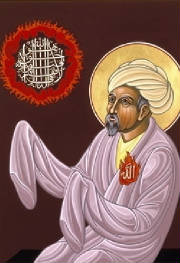
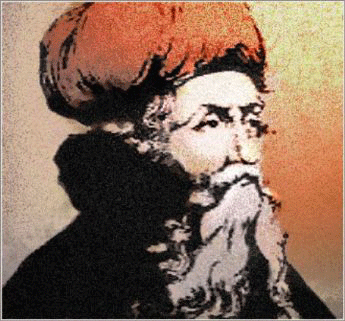
2 Poems by Mansur Al Hallaj
Underlying his fearsome courage was a beautiful tenderness that was forgiving, loving, and filled with wisdom. His deep spirituality was expressed in the most exquisitely poetic way that at the same time is filled with powerfully raw and naked power. His words were imbued with the perplexity that overwhelm a heart drowned in the ocean of love. He spoke in ways that shocked ordinary people but awakened and were understood and cherished by his fellow travelers. Read More »
Becoming Real: Realization and Revelation in Rumi and Ibn ‘Arabi
James Winston Morris
The aim of this essay is simply to point to certain guiding concerns and perspectives that are shared by both these artists, perspectives which are happily subsumed in the multifaceted Arabic technical term tahqīq or “realization” that was particularly favored by Ibn ‘Arabi and the long line of his later interpreters, or muhaqqiqūn. And in examining this subject, we can hopefully suggest something of the unique comprehensiveness and proven effectiveness of Rumi’s and Ibn ‘Arabi’s writings in supporting that wider human task of realization. Read More »
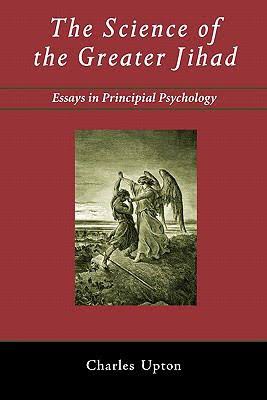
The Science of the Greater Jihad
Few people writing in America today have as deep a grasp of metaphysics as Charles Upton. We commend his new book to anyone interested in spiritual psychology, Sufism, and Islam. It is a well-written in depth study of the spiritual psychology inherent in traditional Sufi practice.
The spiritual life must obviously take psychology into account; if we want to do good and know truth, we will have to understand what in us supports this intent, and what stands in the way of it. But after Jungian Psychology, Humanistic Psychology, Transpersonal Psychology, and Ken Wilber’s Integral Psychology, the reader may wonder what remains to be said vis-à-vis psychology and the Spiritual Path. In the author’s opinion, what remains is to present a psychology rooted in traditional metaphysics, one that he has termed “Principial Psychology”. This psychology is not essentially new; elements of it are to be found in every traditional path; but it has rarely been so explicitly defined. Read More »
On The Inner Dimensions of Islam
A Talk by Ali Allawi on the earliest origins
and the Qur’anic support
for a tradition of inner spiritual practice.
ISLAM AND HUMAN VALUES
Islam and Human Values by Kabir Helminski (with input from leading scholars) was written to address the urgent questions, misunderstandings, and distortions of Islam that are all too prevalent today. The need for a document like this seems to grow daily in the face of Islamophobic propaganda and extremist versions of Islam. Islam and Human Values makes the case that there is an intrinsic Islam with the Qur’an as its reference point that stands for religious pluralism, freedom of conscience, human dignity, social justice, and the spiritual transformation of human beings. It is our hope to raise funds to print a small booklet, illustrated by photos of Western Muslims by great photographers like Peter Sanders, to distribute widely in the English speaking world. This current document may be downloaded and freely distributed. Download the document.
FEMALE PERSPECTIVES OF THE QURAN by Amina Wadud
Amina Wadud, internationally respected Quranic scholar, talks about her life’s work, which has included new insights into how our understanding and appreciation of the Qur’an might benefit from the inclusion of women’s perspectives. The Quran has for centuries been interpreted almost exclusively by men, and some of their assumptions have resulted in excluding or marginalizing women’s sensibilities that could make an important contribution to our understanding. Listen to Amina.
AN INTERVIEW WITH SHAYKH FADHLALLA HAERI

Kabir Helminski conversed with Shaykh Fadhlalla Haeri in Praetoria, South Africa about meeting the spiritual needs of our time, about reason and spiritual intelligence, about spiritual capacities and the power of unconditional love. Listen to this remarkable conversation.
BARAKA: RECONNECTING WITH OUR SPIRITUAL LEGACY
Kabir Helminski
Many spiritually inclined people, and especially those from a Muslim background, face a double alienation in today’s world. On the one hand, they are alienated from the mad rush of contemporary society with its commercialization, its ugliness, its pandering to the ego, and its lack of meaning. On the other hand, they are equally alienated from various expressions of Islam that fail to inspire them. Too often, the teachings of Islam as they are presented seem irrelevant, authoritarian, dogmatic, and one-dimensional. Read More »
RECOVERING THE TRANSCENDENT IN ISLAMIC SPIRITUALITY
Ali Allawi. Few people combine real life experience with spiritual insight as much as Ali Allawi. He has a deep appreciation for the spiritual education once provided by the Sufi orders and the need for reviving an effective language of spirituality. We were delighted to learn that he is also closely associated with our dear friend, Shaykh Fadhlalla Haeri, and thus deeply acquainted with the path of spiritual experience. He has also held positions of responsibility as Minister of Trade and Minister of Defense in the cabinet appointed by the Interim Iraq Governing Council from September 2003 until 2004, and subsequently Minister of Finance in the Iraqi Transitional Government between 2005 and 2006.
The following is an excerpt from Ali Allawi’s The Crisis of Islamic Civilization (With permission from Yale University Press).
The recovery of the sacred, which is integral to any hope for the recovery of Islamic civilization, revolves around the notion of ihsan, the third essential dimension of Islam. In the sensibility of the times, this might veer towards tedious or sanctimonious moralizing, but ihsan has nothing to do with controlling or moulding outer forms of behaviour. It is a conscious pursuit on the part of the individual to perfect virtuous qualities which are associated with the inner spiritual journey. This pursuit was undertaken in the past through affiliation to the various Sufi tariqas, which had millions of adherents and adepts, or, in the Shia lands, through the more individualist and even solitary path of irfan, the metaphysical form of Sufism, which was acceptable to the Shia consciousness. The tariqas cannot be compared to the monastic orders of Christianity, if only because of their scale and ubiquity in Islamic public life. The modernist and Islamist assault on the spiritual paths of Islam destroyed a crucial form of organization which had encouraged the inculcation of moral qualities in the mass of the population as well as in the elites. It was not replaced with anything better than just an alternative: of either a dry ‘rationalist’ or scholastic Islam, or the doubts and moral ambiguities which are a feature of secular life. The ihsan aspect of Islam was degraded over time and, with it, nearly all the features of Islamic life that were marked by charitable works, communal solidarity and social concern. . . Although the traditional Sufi orders may be well past their prime as a vehicle for spiritualizing the masses, the deeper yearning which they had earlier addressed still remains.
RELIGION GONE GLOBAL, an interview with Reza Aslan
posted by Nathan Schneider
Reza Aslan stirs the pot and offers some valuable insights in this stimulating interview–no need to agree with every word of it. We need more voices like his. ~Kabir Helminski
Reza Aslan: “I take very seriously the Sufi notion that religion is an external shell that has to be shattered in order for the individual to be able to unite with the divine. The path that you take is irrelevant; the destination is what’s important. That affects not only my scholarship and my writing about religion, but my own spirituality as well. I think of myself as a person of faith; I believe that there is a reality beyond the material realm, and I want to commune with that reality. But what I’m talking about is so ineffable that I need a language of symbols and metaphors in order to make sense of it to myself and to communicate those ideas to other people. The difference between Judaism, Christianity, and Islam is the same as the difference between French, German, and Spanish. They’re different languages to describe identical sentiments. For me, the language, the symbols, and the metaphors that make the most sense are those provided by Islam: the notion of the oneness of God, the conception of divine unity. These make sense to me in a way that the symbol of the suffering servant on the cross does not, in a way that the symbol of the void in Hinduism does not, and in a way that the symbol of the wheel of rebirth in Buddhism does not. I value those other symbols and languages, and, indeed, I’m literate in them, just as I can communicate in French and Arabic. But I think in English. And I feel my spirituality in the language of Islam.” Read More »
ISLAM AND THE NEW MILLENNIUM
T.J.Winter (Abdal Hakim Murad)
This essay is based on a lecture given at the Belfast Central Mosque in March 1997.
“All too often they follow limited, ideological versions of Islam that are relevant only to their own cultural situation, and have no relevance to the problems of educated modern Westerners. We need to overcome this. We need to capitalise on the modern Western love of Islamic spirituality – and also of Islamic art and crafts. By doing so, we can reap a rich harvest, in sha’ Allah. . .”
Whoever is not thankful for graces
runs the risk of losing them;
and whoever is thankful,
secures them with their own cords.
(Ibn Ata’illah, Kitab al-Hikam)
LOVE IN ISLAM: A Khutbah by Mahmoud Mostafa
In this Khutbah, delivered at the very first planning session for the Baraka Institute in May of 2008, Mahmoud Mostafa reflects on the inner essence of Islam as love.
IS ISLAM A “RELIGION OF THE SWORD”?
Kabir Helminski and Hesham Hessaboula
There are a number of verses in the Qur’an that appear to call for Muslims to kill non-Muslims, and these verses have been too often quoted out of context with what appears to be a willful disregard of the context in which they occur. Read More »
LIVING WITH THE TRUTH: CONCLUSION
EVENTS, VIDEOS
BEING WILLED BY THE TRUTH – Kabir Helminksi
EVENTS, VIDEOS
HAQQ, TRUTH & DIVINE BREATH – Imam Feisal Rauf
EVENTS, VIDEOS
REFLECTIONS ON HAQQ AS RIGHTS – Amina Wadud
EVENTS, VIDEOS
HAQQ & AUTHENTICITY – Abdul Hayy Darr
EVENTS, VIDEOS
CONTEMPLATION WITH SETAR – Kourosh Taghavi
EVENTS, VIDEOS
Qur'an 30:30-32